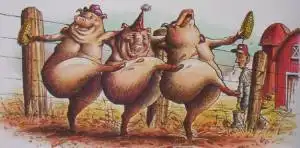
St. Anthony, Patron Saint of Pigs - Faced a Swine of a Spiritual Challange!
"Tantony Pig" is an old English derogatory term for someone who blindly, but fleetingly, follows others. "Tantony" is a middle ages contraction of "St. Anthony" and relates to the story of Saint Anthony (= St. Antony without an "h" in U.S. English) who is the Patron Saint of Pigs.

Great St. Anthony was born in Egypt in 251 CE and rose to fame after a divine battle of porcine transformation.
He was born wealthy but gave all his money away to the poor. He lived a harsh life of prayer, penance, self-deprivation and hard work, yet lived to the ripe old age of 105!
While on a year of solitary retreat and prayer, St. Anthony had the experience of being tempted by Satan who allegedly came to him in the form of a fierce pig which viciously attacked him. Anthony saintily resisted the temptation to return the favour and beat the pig to death, whereupon he was enveloped by a "wondrous light" and the pig was transformed into a humble and docile porcine companion.
Anthony's purity and self-sacrifice, together with his porcine transformation story, attracted a following of disciples and he founded a religious order called the Hospitallers of St. Anthony. Monks of this order founded St Anthony's hospital in London, UK.
Local people gave their "poor-doer" runt pigs to the monks who, in time, became well-known for their free-range pig-raising as well as for their medical support to the suffering. Tantony also came to be a term for a runt pig.
The hospital pigs were allowed to roam freely and scavenge around the city and would follow anyone who looked a likely source of scraps. However, even in the middle ages, "traceability" was an issue and the monks made their pigs traceable by the simple expedient of putting bells around their necks. In time the term "Tantony" also came to be applied to a small peal of bells in bell-ringing.
It also said that monks of the Order of St. Anthony travelled around Europe with bell-wearing porcine companions.
His monks developed a reputation for helping people affected by "St. Anthony's Fire" a gangrenous skin disease which we know today as "Ergotism" - caused by the toxins of the grain fungus Ergot.
In fact St. Anthony also has the rather unattractive appellation of "Patron Saint of Skin Diseases"! Indeed, in the days before antibiotic treatment, prayers to Saint Anthony were the first port of call in cases of swine erysipelas.
Cartoon Illustrations
Cartoon Illustrations